

Every scenario where an activity is performed with subordination needs to lay the cards on the table before starting an employment relationship. It is at this point where the employment contract becomes relevant, since it establishes, in a document, the functions, obligations and labor rights that the company and the employee must assume. It is the legal support that validates the commitments acquired and that both parties have agreed to comply with voluntarily.
In this article you will learn about the fundamental aspects of the employment contract, the cornerstone of labor relations.
What is an employment contract?
Article 22 of the Substantive Labor Code defines an employment contract as. "that by which a natural person undertakes to render a personal service to another natural or juridical person under continuous dependence or subordination of the second and against remuneration."
In turn, Article 23 of the same Code states that for an employment contract to exist, three essential elements must be present, namely: (i) the personal activity of the employee; (ii) the continued subordination or dependence of the employee on the employer; and (iii) a salary as remuneration for the service.
Likewise, by virtue of the provisions of article 37 of the same codification, the employment contract may be verbal or written, complying in each case with the requirements stipulated in the law. However, it should not be lost sight of the fact that any personal work relationship is presumed to be governed by an employment contract and provided that the three essential elements described above are met, it will be understood that an employment relationship exists.
Learn more about: Particularities of the employment contract, interview with Carlos Barco.
¿Cuáles son los tipos de contrato de trabajo?
Now, although there are different ways to classify employment contracts, the most common classification is according to their duration, namely:
Indefinite term contract
The article 47 of the Substantive Labor Code establishes that a contract not stipulated for a fixed term or whose duration is not determined by the work or the nature of the work contracted or does not refer to occasional work will be an indefinite term contract.
The law does not require any formality for its execution, since in fact, in the absence in the agreement of any other modality or in the event that the contract for a specific work or labor is distorted, the consequence is that the contract is understood to be for an indefinite term, which, as its name indicates, has a vocation of permanence in time and unless there is a just cause or the will of the employee, the termination by the employer generates the recognition of a severance pay set forth in the law.
Join our newsletter
Contract for a definite period of time
Within the defined-term contracts are: fixed-term contracts, contracts for specific work or labor, and contracts for occasional work.
Fixed-term contract
In accordance with the provisions of Article 46 of the Substantive Labor Code, a fixed-term employment contract must always be in writing and its term cannot exceed three years, but it is renewable indefinitely. Now, when a fixed term contract is entered into for less than one year, the first three extensions may be equal to or less than the initially agreed term and as from the fourth extension, the renewal must be for a minimum of one year and so on.
In order to terminate the employment contract, regardless of the agreed term, provided that it is longer than one month, a notice of not less than thirty (30) days must be given. In this sense, and if the corresponding notice is not given, the contract will be understood to be renewed for a period equal to that initially agreed and so on.
However, if the fixed term is less than one year, the contract may only be extended successively for 3 equal or lesser periods, after which the renewal term may not be less than one year.
In the event of termination of the contract prior to the expiration of the agreed fixed term, unilaterally and without just cause, the employer shall pay as indemnification, the value of the salaries corresponding to the time remaining for the expected date of termination of the contract.
Contract for specific work or labor
As its name indicates, the duration of the contract is given by the duration of the work or labor agreed upon, and although the law does not specify the requirement of a written document, it is practically the only way to prove exactly what the work or labor contracted consisted of, since its proof is not only for the employer, but it is the one that allows exonerating the payment of any indemnity.
Unlike a fixed-term contract, a contract for work does not require the granting of any type of notice. However, in the event of termination of the contract prior to the termination of the work or labor contracted, the employer must pay as indemnification, the value of the wages for the time remaining for the termination of such work or labor, but in no case the indemnification may be less than 15 days.
Contract for occasional work
Article 45 of the Substantive Labor Code states that employment contracts may be entered into, among others, "to perform occasional, accidental or transitory work.". For its part, Article 6 of the same Code states that this is a short term contract of not more than one month and that refers to work other than the employer's normal activities.
Contrato de Aprendizaje:
El Contrato de Aprendizaje, tras la Reforma Laboral en Colombia (Ley 2466 de 2025), pasó a ser una modalidad especial de contrato laboral a término fijo, regido por el Código Sustantivo del Trabajo. Aunque sigue orientado a estudiantes en formación técnica, tecnológica o profesional, ahora otorga derechos plenos como salario, prestaciones sociales, afiliación integral al sistema de seguridad social y reconocimiento de la experiencia como vínculo laboral formal. La norma también limita su duración a un máximo de tres años y permite la sindicalización de los aprendices, garantizando condiciones más justas y equitativas para su inserción al mundo laboral.
Learn more about: How is an employment contract terminated?
¿Cuáles son los elementos claves de un contrato de Trabajo?
1. Identificación y domicilio de las partes:
Los elementos de un contrato de trabajo incluyen los datos completos del empleador (persona natural o jurídica) y del trabajador, como nombres, documento de identidad, razón social, NIT, dirección y ciudad de residencia. Esta información es esencial para establecer quiénes son los sujetos de la relación laboral y fijar su jurisdicción legal.
2. Lugar y fecha de celebración:
Se refiere al sitio físico y a la fecha en la que se firma el contrato. Este dato determina el momento en que se perfecciona el vínculo laboral y puede ser relevante para efectos probatorios y de prescripción.
3. Lugar donde se prestará el servicio:
Indica el lugar o sede donde el trabajador desarrollará sus funciones. Puede ser un sitio fijo o variable, y debe establecerse con claridad para evitar ambigüedades sobre traslados o desplazamientos. También permite aplicar correctamente normas de seguridad social y riesgos laborales según ubicación.
4. Naturaleza del trabajo:
Describe detalladamente el tipo de funciones o actividades que realizará el trabajador. Esta cláusula delimita el alcance de sus obligaciones, y cualquier cambio sustancial en estas funciones debe contar con el consentimiento del trabajador o respaldo legal.
5. Salario y forma de pago:
Especifica el monto acordado, la periodicidad del pago (quincenal, mensual, etc.), y el método de pago (efectivo, transferencia, cheque). También se pueden pactar pagos en especie, siempre que no superen el 50 % del salario, conforme al Código Sustantivo del Trabajo.
6. Duración del contrato:
Debe establecer si el contrato es a término fijo (con o sin prórroga), por obra o labor contratada, o a término indefinido. La duración impacta directamente en la estabilidad laboral, los preavisos requeridos y el pago de indemnizaciones en caso de terminación.
7. Desahucio y terminación:
Señala las causales legales o contractuales por las que se puede dar por terminado el contrato, así como los procedimientos formales que deben seguirse (como preavisos, indemnizaciones o autorizaciones especiales en caso de trabajadores con estabilidad reforzada).
¿Cómo puede realizarse la terminación del contrato de trabajo?
El contrato laboral en Colombia, aunque nace por la voluntad de las partes, también puede terminar voluntariamente por cualquiera de ellas. La legislación colombiana regula estrictamente esta terminación para proteger al trabajador, considerado la parte más vulnerable en la relación laboral.
Terminación con justa causa
Según el Código Sustantivo del Trabajo, existen causales expresamente establecidas que permiten al empleador o al trabajador dar por terminado el contrato sin obligación de indemnizar. Entre estas causales se incluyen: engaño al empleador con certificados falsos o información fraudulenta, actos de violencia o amenazas graves contra personas, daños intencionales a la propiedad o negligencia grave, incumplimientos contractuales reiterados o violaciones graves a reglamentos internos, entre otros.
El empleador que invoque estas causales debe garantizar un debido proceso: comunicar al trabajador la causal con pruebas, permitir su defensa previa (audiencia de descargos) y, en ciertos casos, dar un preaviso mínimo de 15 días. Una vez cumplidos estos requisitos, no se obliga al empleador a pagar indemnización por despido injustificado.
Terminación sin justa causa
El empleador tiene la facultad de terminar unilateralmente un contrato sin justificarlo, siempre que pague la indemnización establecida por la ley. Esta figura es válida excepto en casos de trabajadores con estabilidad reforzada (como sindicalizados, embarazadas o personas con discapacidad), quienes solo pueden ser despedidos si hay una justa causa calificada.
La indemnización por despido sin justa causa se calcula así:
-
Contrato a término fijo: se pagan los salarios correspondientes al tiempo restante del contrato, con un mínimo legal de 15 días.
-
Contrato a término indefinido:
-
Si el salario es inferior a 10 salarios mínimos mensuales legales vigentes: 30 días de salario por el primer año y 20 días adicionales por cada año subsiguiente o proporcional por fracción.
-
Si el salario es igual o superior a 10 salarios mínimos: 20 días por el primer año y 15 días adicionales por cada año subsiguiente o proporcional.
-
Renuncia o despido indirecto (autodespido)
El trabajador también puede terminar el contrato si el empleador incumple gravemente sus obligaciones o vulnera su derecho a un ambiente laboral digno. En estos casos, puede reclamar indemnización como si se tratara de un despido sin justa causa, e incluso solicitar una compensación por daños y perjuicios si hay lugar a ello.
What constitutes wages?
As previously stated, the salary constitutes one of the essential elements of the employment contract. Indeed, Article 27 of the Substantive Labor Code provides that. "All dependent work must be remunerated".
However, it must be taken into consideration that the employer may make different payments to the employee arising from the same existence of an employment contract; however, not all of them will be classified as salary, the latter being those that are taken into account to form the basis for the liquidation of other labor rights, for example, social benefits, vacations, contributions to the social security system and indemnities.
In order to identify those payments of a salary nature, it is necessary, in principle, to refer to Article 127 of the Substantive Labor Code, which establishes that everything received by the worker in cash or in kind as direct consideration for the service, for example, bonuses, additional wages, regular bonuses, value of supplementary work or work on mandatory rest days and commissions, constitutes a salary.
Next, Article 128 indicates that the sums that occasionally and by mere liberality the worker receives as bonuses, bonuses or occasional gratuities, profit sharing and what he receives not for his benefit or to enrich his assets, but to fully perform his duties such as representation expenses, means of transportation and work items do not constitute salary, nor do the social benefits or the usual or occasional benefits or allowances agreed upon conventionally or contractually or granted extra-legally by the employer, when the parties have expressly provided that they do not constitute salary.
Types, forms and stipulation of salary
In relation to the types of salary, we find (i) salary in cash and (ii) salary in kind. The first is that which, as its name indicates, is paid in money to the worker; the second is all that part of the ordinary remuneration received by the worker as direct consideration for services, such as food or clothing provided by the employer.
Article 132 of the Substantive Labor Code provides that the parties may agree on the salary in its various forms (unit of time, by work or piecework and by task).
Likewise, it states that when the worker earns an ordinary salary higher than 10 legal monthly minimum wages in force, a salary may be stipulated in writing that in addition to remunerating the ordinary work, compensates in advance the value of benefits, surcharges and benefits; which will be increased by a benefit factor that the law presumes is not less than 30%. Therefore, the minimum integral salary in Colombia cannot be less, in total, than 13 smmlv.
Este tema también podría interesarte ➜ conoce cuándo procede la terminación de contrato por justa causa.
Prevent contingencies with our labor auditing service.
What are the social benefits?
Social benefits can be defined as those benefits that by law the employer must recognize to its employees, which are comprised of the following concepts:
Severance pay
The employer, as of December 31 of each year, must pay the severance payment, by annuity or by the corresponding fraction, and such amount must be deposited before February 15 of the following year in the individual account in the name of the employee in the severance fund chosen by him/her (Article 99 Law 50 of 1990).
Interest on severance payments
The employer shall pay the worker the legal interest of 12% per annum or proportional by fraction with respect to the amount caused in the year or fraction that is finally settled (Article 99 Law 50 of 1990).
Service premium
The employer is obliged to pay its employees a bonus corresponding to 30 days of salary per year, which is recognized in two payments; half of which must be made no later than June 30 and the other half no later than the first twenty days of December (Article 306 of the Substantive Labor Code).
Endowment
Every employer shall provide every four months a pair of shoes and a work dress to each worker whose monthly remuneration is up to twice the legal monthly minimum wage in force. The worker who on the dates of delivery has completed more than three months in the service of the employer shall be entitled to this benefit (Article 230 of the Substantive Labor Code).
In addition to the above, there is the concept of vacation that constitutes a paid rest and consists of 15 days of rest for the employee for each year of continuous or discontinuous services rendered.
Find out more about: The specifics of salary and social benefits.
Contributions to the social security system
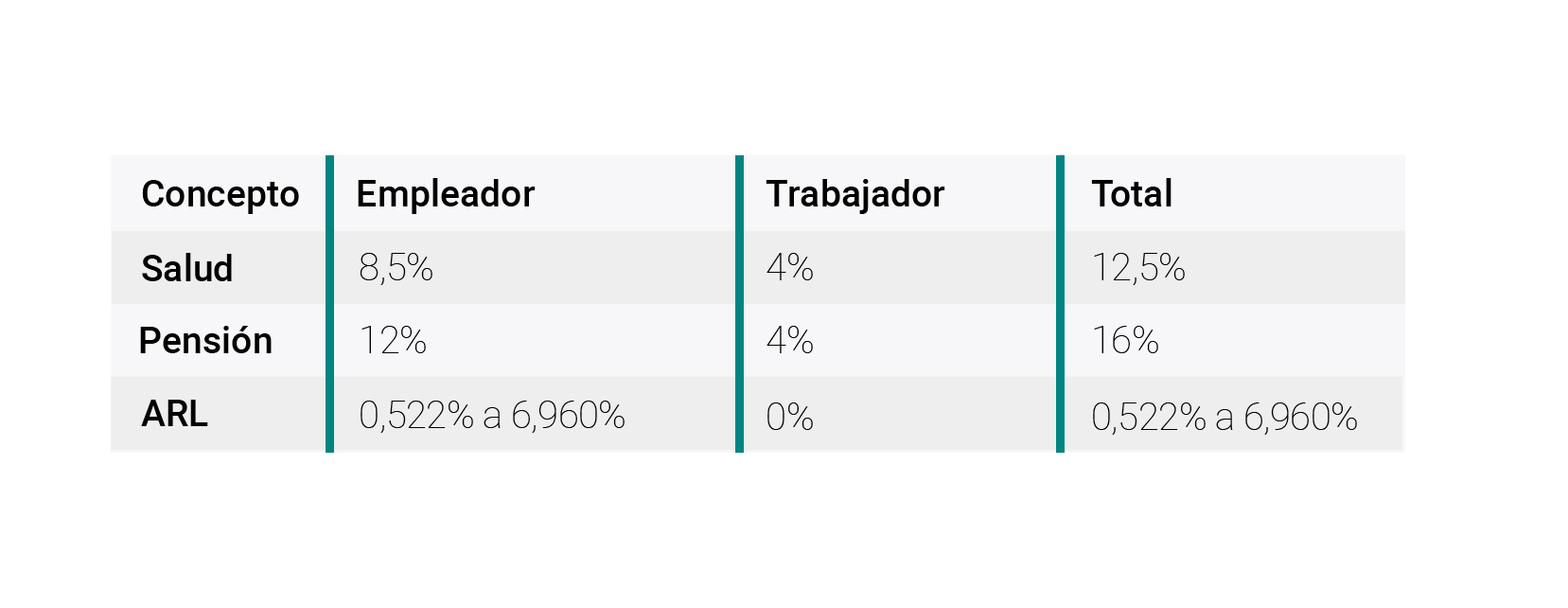
Every employee hired under an employment contract has the right to be affiliated to the Comprehensive Social Security System comprising the health, pension and occupational risk subsystems, as well as the Family Allowance (Family Compensation Funds).
In the health and pension subsystems, the worker will have the right to choose the Health Promoting Entity - EPS and Pension Fund to which he/she wishes to be affiliated. In the case of labor risks, the employer will be the one to choose the Labor Risks Administrator - ARL to which the worker will be affiliated.
However, the law defines the percentages as follows:
These are the main aspects that every employer or future employer should be aware of with respect to the employment contract and individual employment relationships and, in our next publications, we will address each of these in more detail, as well as additional issues to be taken into account with respect to labor relations, such as discriminatory practices in the selection process. discriminatory practices in the selection processes o to whom labor claims caused by the death of an employee are paid.
Learn more news about labor law by browsing our experience repository!
Te asesoramos en la gestión y redacción de contratos de trabajo
Un contrato de trabajo bien estructurado es la base para una relación laboral sólida y sin contratiempos. En Álvarez Liévano Laserna, te brindamos asesoría legal especializada para empleadores, ayudándote a cumplir con la normatividad, evitar errores comunes y reducir riesgos jurídicos.
Nuestro equipo de abogados en derecho laboral te acompaña en la elaboración, revisión y terminación de contratos laborales, con el respaldo de abogados laborales y abogados en línea que entienden las necesidades reales de las empresas en Colombia.

Free download
Ebook: Termination Guide